Saturday, October 31, 2015

Food Processing Part II (Industrial Scale)

****************Trick Or Treat???****************


Happy Halloween, guys!!! How do you feeling today? Do you know what to wear for tonight? I got some ideas for you! How about dressing like a zombie nurse? Or an old Chinese vampire? Or a pirate? Or a witch? It doesn't matter what you wear, let's just get tricky tonight!! Anyway, still wondering what’s gonna be my next post? Well, not to waste anymore time, let’s get started!

Food Processing in industrial scale always consist of many steps. Even the simplest, like processing pickle, we need to do not less than three steps, which are wash, cut and ferment.

Cassava can be harvested about 12-14 months after planting. If we harvest too soon or too late, the starch content is not fit for the production (starch content is not the highest). To process tapioca flour from raw cassava, first we need to peel the cassava. While peeling, the cassava also washed. Then the skin-less cassava being cut and rasped and we have the cassava porridge. After that, the porridge moved to the extractor. The extractor applies centrifugal force to separate the liquid from its pulp. The liquid contains water and tapioca. The liquid then moved to the separator. The separator also applies centrifugal force so in this process also called the second process of centrifugal. The difference between the extractor and separator is that the nozzle is being used in the separator. The nozzle helps in controlling the direction of a fluid flow (especially to increase or decrease the velocity).  In this process, we will separate the tapioca with lower density from high protein water. The tapioca will be moved to the next process while the high protein water will be used again in the extractor. The tapioca will be further filtered to obtain the higher density level. After that, we dry the starch in the oven until the water is all evaporated and the tapioca flour is ready to be used.
  
http://www.fao.org/docrep/x5032e/x5032E0D.GIF

milk = white juice from certain plant (in this case, from cassava root)

To produce one kilogram of tapioca flour, we will need ± 5 kilograms of raw cassava. In large factory, they could produce up to 80 tons of tapioca flour in one day which means they will need ± 400 tons raw cassava. In 1 hectare field, we could only harvest 10 tons of cassava. To harvest 400 tons of cassava, we’ll need ± 40 hectare of cassava fields in one day. So, we could conclude that large factory will need to harvest 40 hectare cassava fields in order to produce tapioca flour per day.

That’s only one of the many kinds of food processing in industrial scale. It’s amazing, right, how people can manage food processes in just one single day so that consumers will never run out of foods and they still could fulfill their needs of food. 

So this is the ending of this session, I will add some flowcharts about food processing products below. I hope you like it. Adios! :D
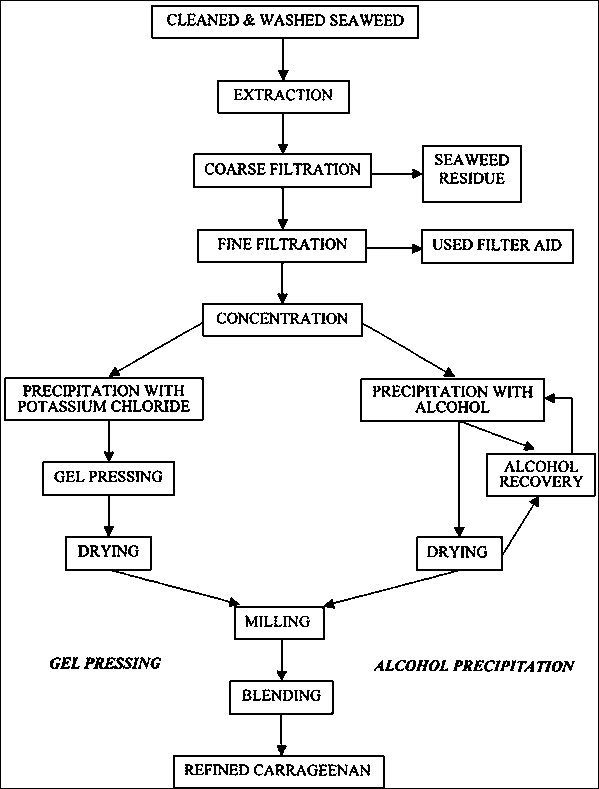
http://www.fao.org/docrep/006/y4765e/y4765e08.gif

http://www.chocolatemixer.in/images/cocoaProcess.jpg

http://www.fao.org/docrep/w0078e/P204.jpg

http://www.agnet.org/htmlarea_graph/library/20110715210310/eb410f2.jpg

Friday, October 23, 2015

How to write Scientific Project Report?

Hello, guys! How are you? It’s been a while since my last post about Jamblang, one of the extinction plants in Indonesia. Do you like it? Please don’t hesitate to leave some comments.
Now, I will share about how to write a scientific project report. I hope you find this useful. Please enjoy!
1.       Title of experiment
Gives an idea of what experiment is about.
2.       Preface
A preface is a brief introduction written by the author about the whole concept of the experiment.
3.       Chapter I (Introduction)
a.       Background
Usually contain information about the object of experiment, history of the object of experiment, reasons why you choose this object.
b.      Aim/Problem Questions
The outlines of what you’re trying to achieve in doing the experiment or a question that you pose or attempt to answer through experimentation.
c.       Hypothesis
A supposition of how things work. This hypothesis is the basis of your research, to prove whether your conjecture is right or wrong.
4.       Chapter II (Literature)
a.       Theoretical Basis
Theoretical Basis includes scientific information founded in journals or based on the interview with professional respondent. If the theory is gotten from the interview, it’s required to attach the recording. Theoretical basis also could contains direct quoted from books.
b.      Methodology
In this section, it’s necessary to explain about the method used in experiment, including the steps taken in order to get the data, then explain why using that method.
5.       Chapter III (Data)
Contain variables and data of experiment. The data is being recorded and organized in this part of report.
6.       Chapter IV (Observation and Discussion)
In this chapter, the data is being analyzed. Usually there are diagrams, graphs and formulas to complete the data. While the discussion is a summary of what have gotten in the experiment, focus on observing the data, tables, diagrams and graphs.
7.       Chapter V (Closing)
a.       Conclusion
Provide a statement that answers the question that written in Problem Question.
b.      Reflection
Reflection gives an opportunity to show what you have learned during the experiment that may not be mentioned in the report.
8.       References
Contains bibliographic information about every source cited in the report.
9.       Attachments
Contain pictures and tables during the experiment.
If you’re confused to differentiate between theoretical basis and backgrounds, just noted that theoretical basis is based on books and journals, means it contains scientific information, unlike backgrounds, it contains general knowledge.
There are many styles to cite references, such as APA ed., Chicago ed., GB7714, ISO 690, etc.
American Psychological Association
rbmabalacat.com

Chicago Fifteen Edition
tex.stackexchange.com


So, that’s it for today. Thank you for visiting my blog. I hope you like what I share ;)

Sunday, October 11, 2015

Jamblang as local food


Bai Dan Gao (Pak Tong Koh)


Food Separation

Hey peeps! Please enjoy my post about how to separate food in large number.

It's easier to separate food on the same phase, like solid from solid or liquid from liquid. For example, to separate stones from rice. We could handpicking but it really takes a lot of time, another method in Indonesia is called "ditampih" which works really good. Another example is to separate sands from rice using "centrifuge" method. How about separating liquid from liquid? We could extract it like in extracting coconut milk from coconut. In separating aromatic liquid from flower, we could first dissolving flower in water to get the aromatic compounds, then distill the compounds and you will get the pure aromatic liquid. Another method in separating liquid from liquid is evaporation, as in separate coconut oil from coconut.

To separate food on different phase, like solid from liquid, we could use separating coffee from its pulps as an example. First, we need to stream the coffee in one big room while we siphon the air. Then slowly we could see some crystal will starting to form. That crystal is the coffee in different phase.

So that's how we separate food in large number. As usual, I'm very welcome if there's any suggestion, just leave your comments below. Peace out! ;)

Sunday, October 4, 2015

Food Quality

Hello, guys! How are you? It's been a rough week for me. But that won't make me forget to keep in touch with you. Now, I want to share with you about food quality.


Characteristic of quality foods is divided into internal and external.
Internal characteristic feature is determined by storability, nutrition facts, flavor, color, hygiene, texture, even shape (not too big or too small).  While external character is influenced by brand, certification, ingredients and price.

Here are some samples of nutrition facts we usually found.
www.marshascandy.com

www.nutritiondata.com


What affects the assessment of the quality of food?
  1. The process of making the product
  2. The main and additional ingredients 
  3. The storage
  4. The nutrition facts
  5. Food certification
www.aziendagricolalatorricella.com


So now, you guys can definitely distinguish between high and low quality food, right? From now on, I hope you can start sorting what you choose to eat. Higher nutrition means higher chance of living a healthy life. Thank you guys for today. Don't forget to leave any suggestion on the comment below :)

Sunday, September 27, 2015

Food Preservation

Hello, peeps! It's been a week since my last post. Now, I want to share with all of you about food preservation.


There are two techniques of food preservation based on the temperature. The first one is using heat to kill bacteria while the other is using cold to prevent the growth of micro-organism. The technique which uses heat to preserve food is divided into two types. There are pasteurization and sterilization. The purpose of pasteurization is only to eliminate pathogenic microorganisms. Pasteurization is usually done at 60o – 105o in Celsius. Unlike pasteurization, sterilization is intended to kill all forms of micro-organisms inside foods. Sterilization is done at an extremely high temperature so that no more microbes or viruses could stay alive, as a result, food could last longer. Generally, pasteurization is used in producing fresh milk, while sterilization is used in producing canned food.

http://www.cs.montana.edu

The microbial growth curve in foods is divided into five distinct phases.
  • Lag Phase
When microbes are introduced into new medium, they take some time to adapt in their new environment, until they’re capable of doing ferment.
  • Acceleration Phase
In this phase, microbes have fully adapted and they‘re starting to replicate themselves, so the number of microbes are slowly growing.
  • Growth Phase
This phase sometimes called logarithmic or exponential phase because the rate of growth number plotting the natural logarithm of microbe number against time in a straight line. During this phase, the replication will continue at a constant rate so both the number of microbes and the rate of population increase doubles in each period of time.
  • Stationary Phase
As the numbers of microbes are increasing, the nutrients inside medium are decreasing. As a result, the rate of microbes’ growth and death are equal.
  • Death Phase
At death phase microbes are died, due to the lack of nutrients, an extreme temperature, or alcohol level that is too high for living condition.


Every fermentation pass through two kind of metabolism.
1.       Primary metabolism is occurs between the acceleration and the growth phase, using energy inside the medium to replicate or reproduce.
2.       Secondary metabolism is occurs in stationary phase. In this kind of metabolism, microbe is producing other compounds.
 
For an example, in producing wine, we are using yeast fermentation. The first thing to do is crush and squeeze the fruit (in this case is grape) until it releases its juice, then add enough yeast and stir the mixture.  This step called starter which is the first phase in microbial growth curve. Then leave the mixture for about a week. In this period of time, the microbe will grow following the curve and will produce alcohol as the other compound. In death phase, the alcohol level will reach its maximum which about 8-12%. If you want to produce wine with higher level of alcohol, you need to fortify the wine. To fortify the wine, you need to do these three following steps. First, take the first half of the wine, left the other half. Second, you need to distill the first half of the wine until you obtain the pure 100% alcohol. Lastly, put the pure alcohol into the other half of the wine. Now you have wine with higher level of alcohol. After that, you need to leave the wine for aging at least a month. Aging is needed to get the exact color and flavor of the wine as we wanted. During this step, we could see pulps begin to form. You could remove the pulp before you bottle the wine. Use bottle or barrel which made from wood to prevent any unwanted changes.
http://www.bbc.co.uk

http://www.bbc.co.uk

http://www.bbc.co.uk

There is another way of fermentation using enzyme instead of microbe. The principle is not much of a different, that enzyme also cannot work in an extreme temperature. Browning apples is only one of the examples of the enzyme inside food. To prevent food from browning, we could put the food inside salty water or blanch the food.


I think it's enough for today, thank you for visiting my blog! If there's any mistake, please feel free to let me know. :D